This section of the website is intended for medical professionals only. To access the client page and online store, please click below.
News
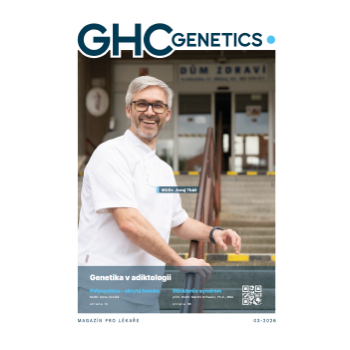
The latest issue of GHC Genetics magazine (3/2026) has been published
26. 08. 2026
Dear readers,
The latest issue of GHC Genetics magazine offers a look at the diverse fields of modern medicine in which genetics is finding ever-wider application. In an interview with our colleague Tereza Lackner, we take a look behind the scenes at healthcare reporting and communication with health insurers. Although this is an area that often remains hidden from patients, its proper functioning is an essential part of the day-to-day running of a healthcare facility. The specialist section of the magazine focuses on the genetic links in addiction medicine and the issue of co-occurring disorders, where current findings in the fields of genomics and epigenetics are opening up new possibilities for personalised care. There is also a case report by Dr Kristýna Kroupová focusing on Stickler syndrome, which highlights the importance of interdisciplinary collaboration and the benefits of modern genetic diagnostics in identifying rare hereditary diseases. We also present an article on polycystic kidney disease, which emphasises that clinical diagnosis alone may not be sufficient and that molecular genetic testing plays a crucial role in determining the prognosis and in the care of other family members. We hope you find this issue inspiring.
Two scholarly articles from the journal *Pohybové ústrojí* featuring Dr. Veronika Krulišová
17. 07. 2026
In the latest issue of the journal "Pohybové ústrojí" (Vol. 32, 2025, No. 1 | Publication date: February 28, 2026), MUDr. Veronika Krulišová, Ph.D., along with other authors, published two scientific papers related to osteogenesis imperfecta:
More infoRepresentatives from the GHC Genetics laboratory attended the prestigious ESHG 2026 conference
07. 07. 2026
We attended the prestigious ESHG 2026 conference, which is one of the leading European events in the field of human and molecular genetics. During the conference, we attended a series of specialized lectures and workshops focused on the latest findings, technologies, and trends in genetic diagnostics. The conference was highly beneficial for us and provided a great deal of inspiration for the further development of our laboratory practices. We were particularly intrigued by the new possibilities of using Trinity technology for the AVITI sequencer, which can significantly streamline and shorten time-consuming sequencing experiments. We also gained new insights into long-read sequencing, which opens up further possibilities for expanding genetic testing.
More info